
11/15 Risk-Off Continues
Monitoring Risk


The S&P 500 ended the week keeping the risk-off environment active, closing below the short term trend, a negative market breadth where more stocks made new lows versus new highs, and momentum continued pointing downward.
This simple system drives the core decisions in managing my portfolio— when to be participating long, when to position defensively, and when to take a bet on the downside.
How I Think About The Risk-Off Alarm
Three core criteria determine the alarm status:
S&P 500 price relative to the short term trend (20-day moving average, exponential)
Breadth as measured by number of stocks making new highs versus new lows across the NYSE and Nasdaq markets
Momentum measured by the Price Percentage Oscillator
When all three are active a risk-off alarm is issued and the market environment is categorized as risk-off. The following trading day must close below the short term trend to confirm the alarm signal.
Here is how I use and think about the alarm.
Risk-Off Alarm
Triggered when trend, breadth and momentum simultaneously close negative
Signals a risk-off environment
Reduce long exposure, take profit/review closing individual trade ideas, hedge long exposure, consideration for short trades
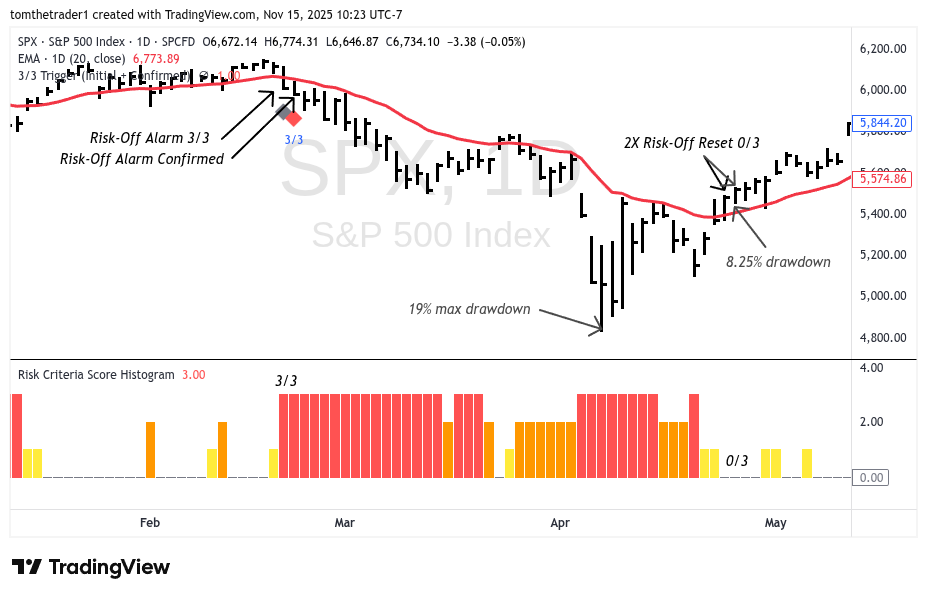
The environment is defined as risk-off from the confirmed alarm signal to the point where the risk-off criteria record 0/3 for two sessions. Throughout the risk-off period the criteria can oscillate between 1-3
This scenario transpired this year. February 21 marked a risk-off alarm signal, confirmed on Monday February 24. The S&P 500 declined as much as 19% over the following month and a half. The risk-off environment reset on April 25, avoiding an 8.25% drawdown from the confirmed risk-off alarm.
Risk-Off Criteria 0-2 (In Absence of Risk-Off Environment)
In the absence of an alarm triggered risk-off environment, the risk criteria will oscillate between 0-2
Signals an environment to position long, consider individual trade ideas, identify core trades for outperformance. This environment I’ve recently described as bullish until proven guilty. I do not complicate it anymore than “stay long”
Risk-off alarms can trigger during this period— without next day confirmation the alarms can be quickly dismissed
This is the scenario that transpired following the April low this year. The index rallied 22% from the risk-off alarm resetting to 0/3. There were two risk-off alarms (August 1 & October 10) that failed confirmation.
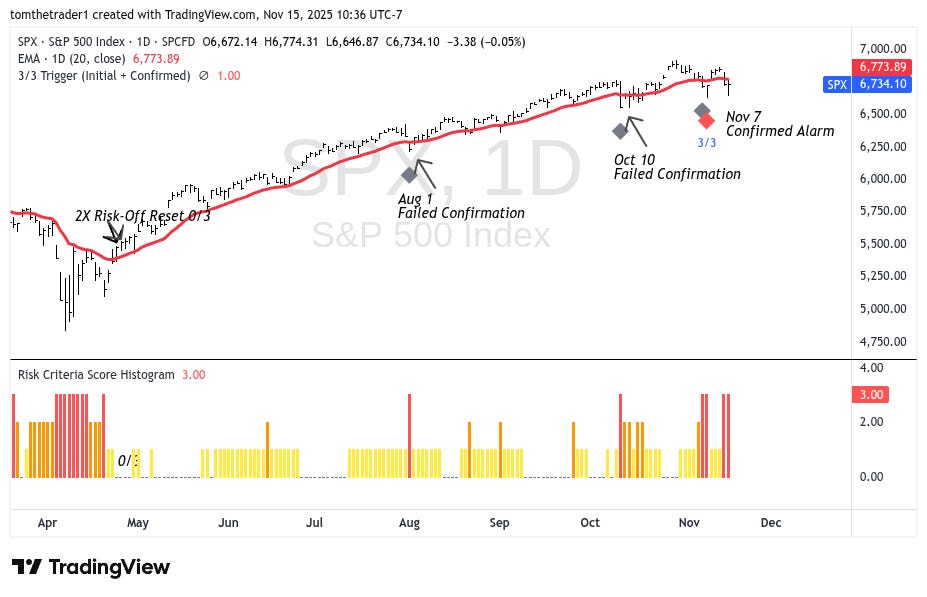
This year has been ideal for the alarm system, however this is not always the case. The system has been wrong, and will certainly be wrong in the future.
2024 is a good example of a year that challenged the system. Four confirm risk-off alarm signals set from August through December, three of which were false where no market decline was avoided. I have accepted sustaining drawdown from incorrect hedging or early profit taking on false signals in exchange for being correct in advance of the more severe declines.
While I hope to further improve the system over the years to reduce the risk of false signals occurring, there is no expectation to always be correct.
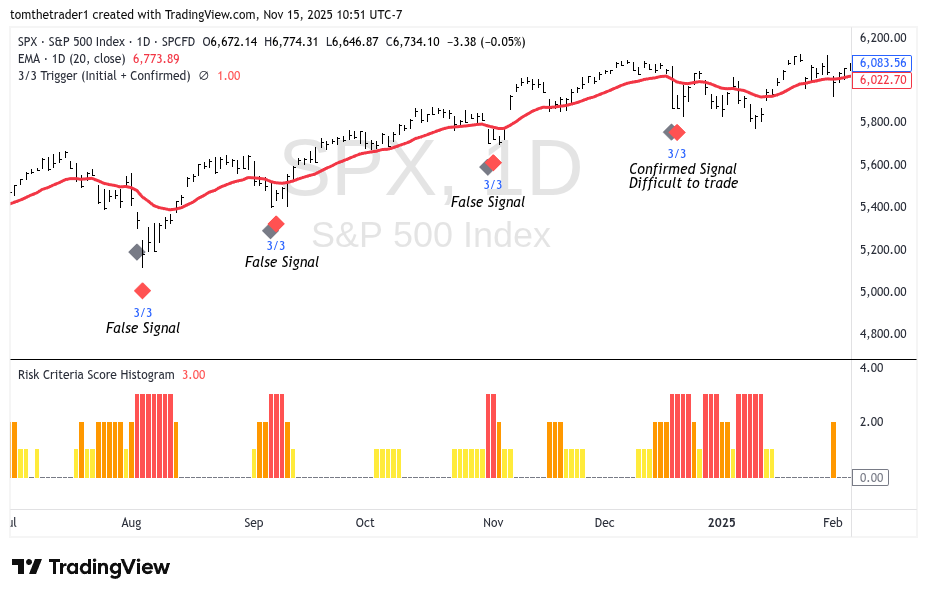
The intent of the system is to signal environments where the wind is at your portfolio back to position long and ride the rally, and mark periods of risk-off where capital preservation is the priority.
The system is not designed to mark an exact top or a bottom. While the risk-off alarms tend to occur at or near highs, the reset criteria often lag the low by quite a bit. Additional analysis of technical price levels, sentiment, risk-on barometer performance, bonds and equity positioning aid in capturing the shifting environment and rounding out the weekly analysis.
Risk Off Criteria: 3 of 3 Active
The core risk analysis ended last week with 3 of 3 active criteria.